What is 3D LED display and how does it work? This question sits at the center of modern outdoor visual technology. A 3D LED display uses thousands of individually controlled light-emitting diodes to create bright, moving images. Unlike conventional screens, it uses carefully designed perspective, depth cues, and camera angles. These elements make objects appear to extend beyond the display surface.
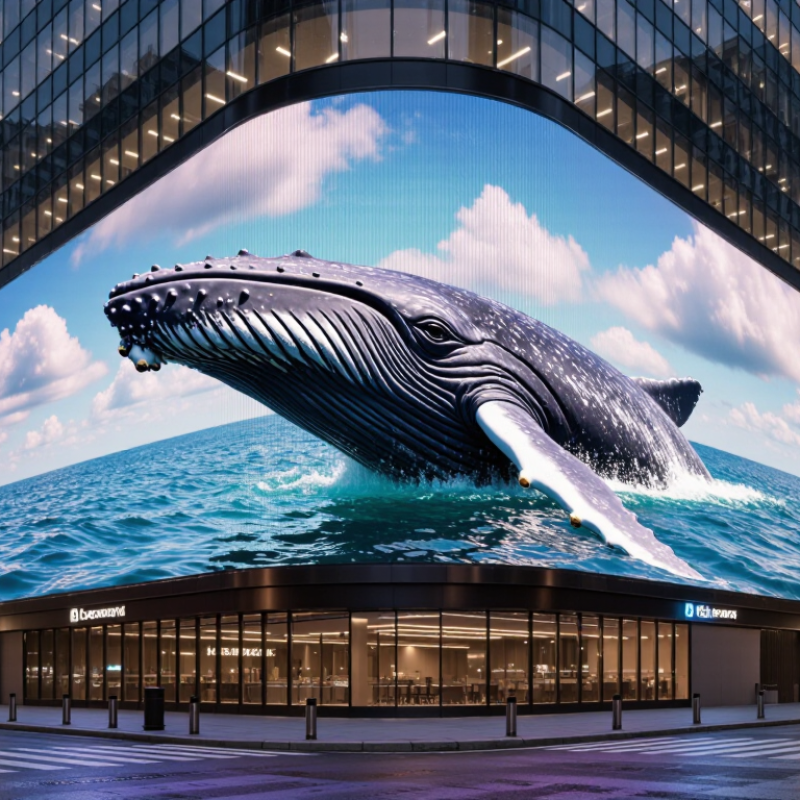
Dr. Douglas Lanman, a leading researcher in computational displays, explains, “A light-field display recreates the light rays entering the viewer’s eyes.” This principle helps clarify the illusion. The screen does not create physical objects in the air. Instead, it presents different visual information to each eye or viewing position. At the right angle, a spinning product may seem to push through a building façade. A virtual whale can appear to swim above a city street.
The process begins with a 3D model or specially produced animation. Software converts that content into perspective-based frames. The LED controller then sends precise signals to each module. Brightness, contrast, refresh rate, and viewing distance must work together. Small calibration errors can weaken the effect.
It is not magic.
It is coordinated light.
Some displays rely on curved cabinets, while others use flat screens with optical techniques. Results vary by design, content, and viewer position. This limitation deserves attention. A 3D effect may look powerful from one location but less convincing from another. Understanding these technical details helps businesses choose displays responsibly, rather than treating every “holographic” claim as identical.
What a 3D LED Display Is
A 3D LED display is a large screen that creates depth-like images with bright light-emitting diodes. It does not usually produce physical objects in the air. Instead, it controls separate red, green, and blue pixels to form detailed moving pictures. Carefully designed content uses perspective, shadows, size changes, and motion. These visual cues can make a person, vehicle, or product appear to move beyond the screen. The effect is strongest when viewers stand within the intended viewing area.
Behind the image, receiving cards and control systems manage thousands of LED modules. Each module contains tiny diodes arranged in a grid. The system updates their brightness many times each second. A processor then matches the content with the screen’s shape and viewing angle. Curved screens can improve the illusion. However, 3D results depend more on content design than hardware alone. Poor angles or excessive brightness can weaken the experience. Real installations often need testing, and initial predictions may be wrong.
Tips: Keep important objects near the visual center. Use strong contrast and gradual movement. Leave enough empty space around floating elements. Check the display during daylight and at night. A short viewing test can reveal uncomfortable depth effects. Do not assume every angle will look equally realistic. Temperature, moisture, and maintenance also affect performance. Clear technical records support safer, more reliable operation.
A 3D LED display combines LED modules, driver ICs, a control processor, power units, and a supporting cabinet. Each module contains thousands of red, green, and blue LEDs. Driver ICs regulate brightness and color at high speed. The processor then sends precisely timed images to each module. This coordination creates smooth motion and stable depth.
The display does not physically project objects into the air. Instead, software builds perspective, scale, shadows, and motion. A curved screen or corner installation strengthens the illusion. Fine pixel pitch also improves close-viewing detail. MarketsandMarkets estimates that the global LED display market will grow from about USD 7.4 billion in 2023 to USD 11.7 billion by 2028. This growth reflects demand for large, immersive visual systems. However, bigger is not always better. Poor content can weaken even an excellent screen.
Tips: Check pixel pitch, refresh rate, grayscale performance, and viewing distance together. A high refresh rate helps reduce camera flicker. The U.S. Department of Energy reports that LED technology can use at least 75% less energy than traditional lighting. Yet display power still rises with brightness and screen size. Heat management matters. Ventilation paths, temperature sensors, and stable power supplies protect image consistency. Designers should test content from real audience positions. The best-looking angle may be surprisingly narrow.
A 3D LED display builds bright visual images from thousands of tiny light-emitting diodes. Each pixel usually contains red, green, and blue LEDs. By adjusting their electrical current, the display mixes these colors into precise shades. A dark pixel receives little power, while a bright white pixel activates all three color channels strongly.
The process happens rapidly. Control circuits send image data to each pixel, while pulse-width modulation manages brightness. This creates smooth color changes, sharp edges, and moving images. High refresh rates also reduce flicker when people record the screen with a camera. In a large display, pixels are arranged across modular panels, with narrow gaps between them. From a distance, the separate lights merge into one continuous picture.
A 3D effect usually depends on visual tricks, not physically floating pixels. The content uses perspective, shadows, depth layers, and carefully timed motion. Curved screens can strengthen the illusion by guiding images toward the viewer’s field of vision. I have found that depth becomes more convincing when highlights match the imagined light source. Small calibration errors can make an object look flat or strangely stretched. The result is not magic. It is coordinated light, geometry, and human perception. Viewing distance matters too; an image that looks impressive nearby may lose depth farther away. Calibration should be checked with real test patterns, not visual confidence alone.
Each LED pixel creates color by combining red, green, and blue light-emitting elements. In a common 8-bit-per-channel system, every color channel can display 256 intensity levels, producing 16,777,216 possible RGB color combinations. Brightness is controlled by rapidly switching each LED on and off using pulse-width modulation (PWM).
A 3D LED display creates depth through brightness, perspective, and controlled motion. Its LED modules show slightly different images across viewing zones. Your left and right eyes then receive different visual information. The brain combines these views into one scene with apparent depth. No glasses are usually required. The illusion becomes stronger when objects move toward the viewer, shrink into distance, or pass behind virtual edges.
Curved screens improve this effect. Their shape supports wider viewing angles and smoother perspective changes. High refresh rates also reduce flicker during fast motion. A 2024 industry analysis by Grand View Research estimated the global LED display market at about USD 7 billion in 2023, showing the scale behind large-format visual systems. Meanwhile, the Society for Information Display continues to identify brightness, contrast, and viewing angle as key factors in perceived image quality. These figures describe the display industry broadly, not every 3D installation. That distinction matters.
Tips: Keep the main object near the screen’s visual center. Use short motion paths and strong contrast. Test content from several distances. A dramatic image may fail from the side. I have found that restrained movement often feels more realistic than constant visual explosions. Calibration remains essential. Small alignment errors can make depth look flat, or strangely distorted.
A 3D LED display creates depth by controlling light, perspective, and image movement. Its panels use thousands of light-emitting diodes to produce bright, detailed visuals. Special content places objects beyond or behind the screen’s surface. Viewers usually experience the effect without wearing glasses. The illusion works best from a planned viewing area.
These displays appear on shopping-center facades, where virtual products seem to extend toward passing pedestrians. They also support tourism campaigns in busy squares, transport hubs, museums, and entertainment venues. At sporting events, a 3D animation can make a ball, vehicle, or mascot appear to cross the screen. Retailers use the effect for product demonstrations, especially when texture and movement matter. Indoor installations often serve as interactive backdrops for exhibitions and public events.
Installation teams must study viewing distance, screen brightness, weather, and surrounding light. A display facing direct sunlight may lose some depth and color accuracy. Curved screens can strengthen the illusion, but they also demand careful content calibration. The result is not magic.
It is engineered perspective.
In practice, the effect is not perfect from every angle. Some viewers may notice distorted edges or flat-looking objects. Content creators should test animations on the actual screen, not only on a computer monitor. Safety also matters around roads and crowded venues, where excessive motion could distract people. A well-designed installation balances visual excitement with clear, responsible communication.
| Display Aspect | What It Is | How It Works | Typical Application | Representative Technical Data | Key Benefit |
|---|---|---|---|---|---|
| 3D LED Display | A large-format display that uses LED modules to present images with depth perception rather than only a flat, two-dimensional appearance. | Computer-generated content provides separate perspective information for the left and right eyes, or uses visual depth cues that create a three-dimensional effect. | Outdoor advertising, architectural façades, public spaces, entertainment venues, exhibitions, and immersive retail environments. | Modular LED panels; common pixel-pitch range: approximately 2.5–20 mm; refresh rates commonly above 1,920 Hz for camera-friendly operation. | High visibility, strong visual impact, and suitability for very large viewing areas. |
| Glasses-Free 3D | A 3D presentation that can be viewed without wearing special glasses. | Content is designed for a defined viewing zone. Perspective, shading, motion parallax, and occlusion cues guide each eye to perceive depth. | Urban media façades, shopping centers, museums, transport hubs, and experiential advertising installations. | Best results generally occur within a controlled horizontal viewing angle and a planned distance from the screen; content must be matched to the display geometry. | Easy public access because viewers do not need wearable equipment. |
| Stereoscopic 3D with Glasses | A display system that delivers different images to the viewer’s left and right eyes through active or passive glasses. | The display presents two synchronized image channels. The glasses separate the channels so each eye receives its intended perspective. | Simulation, 3D cinema, medical visualization, engineering review, training, and controlled entertainment environments. | Requires compatible glasses, synchronized content, and adequate separation between the two image channels. | More precise control of binocular depth than many glasses-free systems. |
| Anamorphic 3D LED Screen | A specially shaped or strategically framed LED installation that makes flat content appear to extend beyond the physical screen. | Perspective distortion is calculated from a primary viewing position. The screen shape and content geometry work together to create an optical illusion of depth. | Building corners, digital billboards, landmark façades, retail windows, and public art installations. | Often uses two perpendicular display planes or a carefully designed screen outline; the strongest effect is visible from a designated viewing zone. | Creates a strong depth illusion without requiring glasses or mechanical movement. |
| LED Pixel Structure | The repeated arrangement of red, green, and blue light-emitting diodes that forms the image. | Each pixel changes color and brightness through independent control of its red, green, and blue components. Millions of pixels together form moving images. | All LED display formats, including indoor, outdoor, flat, curved, and corner installations. | Typical brightness: about 600–1,500 nits indoors and roughly 4,000–10,000 nits outdoors, depending on ambient light and design requirements. | High brightness, scalability, and visibility in daylight when properly specified. |
| 3D Content Production | The process of creating digital scenes that contain depth, perspective, lighting, and motion information. | 3D models, cameras, textures, lighting, and rendering software generate frames that are adapted to the LED screen’s dimensions and viewing position. | Advertising campaigns, product launches, virtual production, education, cultural displays, and entertainment. | Content should be rendered at the display’s native aspect ratio and resolution; common professional video rates include 24, 25, 30, 50, or 60 frames per second. | Allows the visual effect to be tailored to a specific screen shape and audience viewpoint. |
| Control and Processing | The electronic system that receives, scales, synchronizes, and distributes video data to LED modules. | Media servers and display controllers map each video frame to the correct cabinet or module while maintaining timing across the entire screen. | Large LED walls, multi-screen installations, live events, broadcast environments, and synchronized architectural displays. | Important factors include input resolution, processing latency, frame synchronization, signal redundancy, and compatibility with the required video format. | Maintains image alignment, smooth motion, and consistent playback across many modules. |
| Outdoor Advertising | A high-brightness LED display used to communicate visual content in public outdoor locations. | High-luminance LEDs and weather-resistant cabinets keep content visible under changing daylight and weather conditions. | Roadside billboards, commercial districts, building façades, transit areas, and large public squares. | Outdoor systems commonly require weather protection, suitable viewing distance, automatic brightness control, and an enclosure rating appropriate to the installation environment. | Captures attention from long distances and supports dynamic content updates. |
| Retail and Brand Experience | An immersive display used to present products, campaigns, and interactive visual stories in commercial spaces. | Depth effects, product animation, synchronized lighting, and sensor-triggered content can increase perceived immersion and engagement. | Flagship stores, shopping malls, showrooms, product demonstrations, and trade exhibitions. | Indoor displays commonly prioritize fine pixel pitch, controlled brightness, low viewing distance, accurate color reproduction, and quiet operation. | Transforms product presentation into an interactive and memorable visual experience. |
| Education and Visualization | A display used to communicate complex spatial information in a more intuitive visual format. | Layered 3D models and real-time rendering show structures, processes, environments, or scientific data from multiple viewpoints. | Classrooms, science centers, laboratories, medical training, engineering review, and museums. | Useful specifications include stable color reproduction, low image latency, sufficient resolution for fine detail, and viewing access for groups. | Helps audiences understand scale, structure, movement, and spatial relationships. |
| Entertainment and Events | A large LED display integrated into concerts, sports venues, stage productions, or immersive attractions. | Real-time graphics, camera feeds, visual effects, and synchronized playback create depth-enhanced scenes for spectators. | Concert stages, theaters, sports arenas, festivals, theme parks, and temporary exhibitions. | Common priorities include high refresh rate, fast processing, low latency, mechanical reliability, and safe viewing brightness. | Supports dramatic backgrounds, live visual effects, and audience immersion. |
Note: The technical figures are representative ranges for general planning. Actual performance depends on pixel pitch, screen size, ambient light, content design, viewing distance, installation geometry, and system configuration.
It is a large screen that creates depth-like images with bright light-emitting diodes. It does not usually project physical objects into the air. The illusion comes from light, perspective, shadows, and movement.
Separate red, green, and blue pixels form detailed moving images. Content changes object size, position, contrast, and motion. These visual cues can make objects appear beyond the screen.
Usually, no glasses are required. Viewers see the effect directly from a planned viewing area. The result may look flatter from other positions.
They appear on building facades, shopping centers, transport hubs, museums, and public squares. They also support exhibitions, sporting events, tourism campaigns, and retail demonstrations. A virtual ball might seem to cross the screen.
No. The strongest effect usually appears within a specific viewing zone. Some angles may show distorted edges or flat-looking objects. This limitation is easy to overlook.
No. Content design often matters more than the screen hardware. Curved surfaces may strengthen depth, but they require careful calibration. Initial predictions can be wrong.
They should keep important objects near the visual center. Strong contrast and gradual movement usually improve readability. Empty space helps floating elements appear clearer. Testing on the real screen remains essential.
Daylight, nighttime lighting, temperature, moisture, and maintenance can change the result. Direct sunlight may reduce depth and color accuracy. Brightness should be checked at different times. Real conditions are less predictable.
Yes. Excessive motion can distract people near roads or crowded venues. A short viewing test may reveal uncomfortable depth effects. Clear technical records support safer operation.
A 3D LED display is a digital screen designed to create the visual impression of depth, making images appear more lifelike and dimensional than those shown on a conventional flat display. What is 3D LED display and how does it work? It uses an organized array of LED modules, control systems, power supplies, cabinets, and image-processing components to produce carefully timed visual content. Each LED pixel combines different light colors at varying brightness levels, allowing the screen to create vivid images, strong contrast, and smooth movement.
The 3D illusion is produced by coordinating perspective, image layering, lighting, and motion. When visual elements are positioned and animated to match how people perceive distance, objects can seem to extend beyond the screen or move within a deeper space. These displays are commonly used in advertising, retail environments, public spaces, entertainment venues, exhibitions, transportation areas, and architectural installations. Their brightness, flexibility, and ability to attract attention make them effective for presenting immersive messages and memorable visual experiences.

Xiguang Display