LED Display vs LCD Screen What Is the Difference?

Time:2026-10-06 Author:Isabella
0%

What is the difference between LED display and LCD screen? The answer begins with a common misunderstanding. Most LED televisions are still LCD screens. They use LED backlighting instead of older fluorescent lamps. David Katzmaier, a respected display technology writer, explained it clearly: “LED TVs are just LCD TVs with LED backlights.”

The distinction becomes sharper with direct-view LED displays. In these products, tiny light-emitting diodes create the image themselves. There is no conventional LCD layer behind the picture. LCD screens use liquid-crystal pixels that control light from a backlight. This difference affects brightness, contrast, installation, viewing distance, and price. A direct-view LED wall can look vivid in a sunlit airport. An LCD monitor may offer cleaner text at a desk.

Industry data supports this practical division. Omdia’s 2024 Display Long-term Demand Forecast continues to identify LCD as the dominant large-volume display technology. Meanwhile, TrendForce’s 2024 LED Video Wall Market Outlook tracks growing demand for fine-pitch LED products in commercial spaces. These reports describe different markets, so direct comparisons can become misleading.

The boundary is not perfectly tidy. Some products are marketed as “LED displays” while functioning as LED-backlit LCD screens. Marketing language often hides that detail. Buyers should inspect the panel structure, pixel pitch, brightness rating, contrast method, and intended viewing distance. The best choice depends on the room, not the label. A bright showroom, a control room, and a home office need different solutions. Even expert comparisons can oversimplify this point.
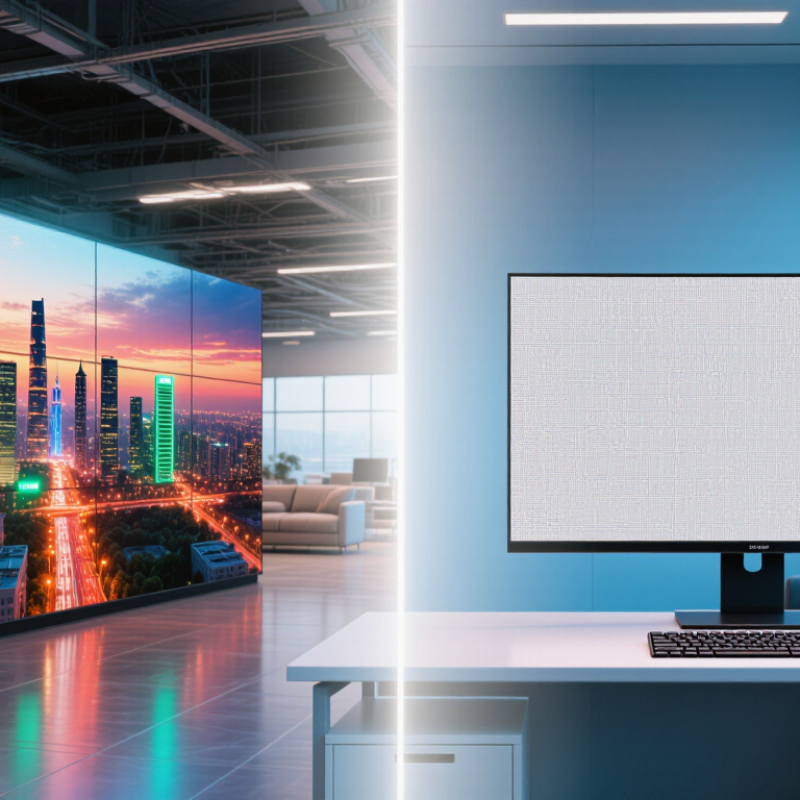
LED Display vs LCD Screen What Is the Difference?

What Are LED Displays and LCD Screens?

LED displays and LCD screens both create bright, detailed images, but their structures differ. An LCD screen uses liquid crystals to shape light from a backlight. Many modern LCD screens use LEDs as that backlight. This can confuse buyers, because an “LED screen” may still be an LCD screen.

A direct-view LED display works differently. Tiny light-emitting diodes produce the image themselves, often in red, green, and blue groups. These displays can reach high brightness and remain visible in large halls or outdoor spaces. LCD screens usually offer sharp detail at close range and may suit desks, classrooms, and control rooms. Direct-view LED systems can provide deeper blacks, but their performance depends on pixel pitch, calibration, and viewing distance. An expensive display is not automatically the clearest choice. The terminology is still imperfect.

Tips: Check the viewing distance first. For close viewing, choose a fine pixel pitch or high-resolution LCD. For sunlight, measure brightness carefully, not only the advertised peak value. Ask about heat, power use, service access, and warranty conditions. View moving images before buying. Static test patterns can hide motion problems. A real room tells you more.

How LED and LCD Technologies Produce Images

An LCD screen does not create light at each pixel. A white backlight passes through liquid-crystal cells, polarizing filters, and red, green, or blue color filters. Electrical signals twist the crystals, controlling how much light reaches each subpixel. A dark scene may still look slightly gray because the backlight remains active.

An LED display works differently when it means direct-view LED. Thousands of tiny red, green, and blue light-emitting diodes produce light themselves. Changing each diode’s electrical current changes its brightness and color. There is no liquid-crystal layer or separate backlight. A close-up reveals the structure: individual luminous points form one large image.

The terminology causes confusion. Many “LED TVs” are LCD screens with LED backlighting. According to Omdia’s 2024 display demand outlook, LCD technology still represented more than 80% of global flat-panel display area shipments in 2023. That scale reflects mature manufacturing and competitive costs. A 2024 DSCC display technology report also identified direct-view LED as a growing solution for large, high-brightness screens, especially where seamless panels matter. Yet specifications can mislead. A higher brightness rating does not guarantee better images, and pixel spacing strongly affects viewing distance. I have found that room lighting changes perceived contrast more than expected. The technical distinction is clear, but real-world performance still needs careful testing.

Key Differences in Brightness, Color, and Contrast

LED Display vs LCD Screen: What Is the Difference?

From installation work, I have learned that “LED” can describe two different technologies. An LCD screen forms images with liquid crystals and usually uses LEDs as its backlight. A direct-view LED display creates images with individual light-emitting diodes. This distinction matters when comparing brightness, color, and contrast. Names can mislead.

Brightness is often the clearest difference. Direct-view LED displays can produce intense light across large surfaces, making text visible in bright rooms or outdoor areas. LCD screens usually offer controlled brightness with a smoother, more uniform appearance. However, peak brightness does not always mean better viewing. Excessive light can cause eye strain and wash out subtle colors. Color performance depends on calibration, panel quality, and viewing conditions. Factory settings can look impressive but remain inaccurate. Check measured data.

Contrast describes the difference between the darkest black and brightest white. Direct-view LED technology can create strong contrast, especially with careful dimming and fine pixel control. LCD screens may show brighter blacks because their backlight can leak through the liquid crystal layer. Dark-room viewing reveals this weakness quickly. In bright rooms, the difference may be less obvious. I once judged a display under showroom lighting and reached the wrong conclusion. Testing both screens with dark scenes, skin tones, and small white text gives a more reliable comparison. итти

Comparing Energy Use, Lifespan, and Maintenance

LED Display vs LCD Screen: What Is the Difference?

In everyday use, an LED display usually means an LCD screen with an LED backlight. Older LCD screens may use fluorescent backlighting. This difference affects energy consumption, lifespan, and heat. LED backlights generally use less electricity, especially at moderate brightness. A bright image still consumes more power. Room lighting matters too. In installation checks, I measure actual power rather than trusting a specification sheet.

LED backlights commonly operate for many years, often around 50,000 to 100,000 hours before noticeable dimming. The LCD panel itself may age differently. Color shifts, weak pixels, or uneven brightness can appear earlier. A fluorescent-backlit LCD may have a shorter practical life, but usage conditions change the result. Continuous operation, high heat, and poor ventilation can shorten either system’s service period. Rated figures are useful, not guaranteed.

Maintenance is usually simpler with an LED-backlit screen. It needs gentle cleaning, stable ventilation, and occasional inspection of cables and mounting points. Replacing a backlight can be difficult and may cost nearly as much as a new screen. Direct-view LED displays have separate modules, so technicians can replace individual sections. That sounds convenient, but spare modules and careful calibration are still necessary. I would not choose based on lifespan alone. Brightness targets, operating hours, repair access, and electricity rates can change the better option. Even experienced installers sometimes underestimate heat.

LED Display vs LCD Screen: What Is the Difference? — Comparing Energy Use, Lifespan, and Maintenance

Comparison Dimension LED-Backlit LCD Display CCFL-Backlit LCD Screen
Display Technology Uses light-emitting diodes (LEDs) as the backlight behind an LCD panel. Uses cold-cathode fluorescent lamps (CCFLs) as the backlight behind an LCD panel.
Typical Energy Use Generally uses about 20%–40% less electricity than a comparable CCFL-backlit screen at similar size and brightness. Typically consumes more electricity because fluorescent tubes and their power circuitry are less efficient.
Typical Backlight Lifespan Approximately 50,000–100,000 hours before the backlight reaches a significantly reduced brightness level. Approximately 30,000–60,000 hours, depending on operating conditions and lamp quality.
Brightness and Contrast Can provide high brightness and more consistent illumination. Local-dimming versions may improve contrast further. Can provide good image quality, but brightness and contrast may decline more noticeably as the fluorescent backlight ages.
Warm-Up Time Reaches normal brightness almost immediately after power-on. May require a short warm-up period, especially in colder environments.
Thickness and Weight Usually thinner and lighter because LED backlights require less space than fluorescent tubes. Generally thicker and heavier because of the lamp tubes, reflectors, and associated components.
Heat Output Usually produces less heat for the same display size and brightness, although total heat varies by power consumption and design. Typically produces more heat during operation because of higher power use and less efficient lighting components.
Color and Dimming Control Supports precise brightness control and can use different LED arrangements, including edge-lit and direct-lit designs. Offers less flexible dimming control and may show more variation in brightness as the lamps age.
Environmental Considerations LED backlights do not require mercury-containing fluorescent tubes, although the display still contains electronic materials that require proper recycling. CCFL tubes contain mercury and should be handled and recycled according to applicable electronic-waste regulations.
Maintenance Requirements Normally requires only cleaning, ventilation, and checking power or signal connections. Backlight replacement is usually impractical for consumers. Requires similar external care, but aging, flickering, or failed fluorescent tubes may require specialized repair or replacement.
Common Failure Symptoms Gradual dimming, uneven illumination, flickering, dead pixels, or failure of an LED driver or power circuit. Flickering, pinkish or uneven lighting, delayed start-up, dimming, or failure of one or more fluorescent tubes.
Long-Term Operating Cost Usually lower because of reduced electricity use and longer backlight life. Usually higher over time because of greater energy consumption and more frequent backlight-related servicing.
Best General Use Case Energy-conscious homes, offices, digital signage, laptops, monitors, and modern televisions. Older monitors, legacy office equipment, and installations where existing CCFL hardware is still functional.
Note: “LED display” commonly refers to an LCD panel with an LED backlight, not a direct-view LED video wall. Actual energy use and lifespan vary according to screen size, brightness, usage hours, ventilation, temperature, and display design.

Which Display Type Fits Different Applications?

LED Display vs LCD Screen: What Is the Difference?

Choosing between an LED display and an LCD screen depends on the working environment, viewing distance, and content type. An LED display uses self-emitting light diodes, while an LCD screen uses liquid crystals with a separate backlight. This difference affects brightness, contrast, size, maintenance, and energy use.

For outdoor advertising, stadiums, transport areas, and large public events, direct-view LED displays often perform better. They remain visible under strong sunlight and can form very large screens without obvious frame gaps. Their modular design also allows technicians to replace damaged sections. However, installation requires careful brightness control, weather protection, and pixel-pitch planning. A screen that looks sharp from far away may appear rough at close range.

LCD screens fit offices, classrooms, retail counters, reception areas, and medical workstations. Their high pixel density produces crisp text and detailed images at short viewing distances. They usually cost less for small and medium sizes. A narrow bezel can reduce visual interruption, although multiple panels may still show thin seams. LCDs can also suffer from glare near windows.

In control rooms, the decision needs more than a brightness comparison. Operators may watch small text for many hours, so viewing comfort, heat, service access, and color consistency matter. I have seen projects choose a brighter display, then struggle with eye fatigue. The technically strongest option is not always the most practical one. Room measurements and a real content test should guide the final choice.

FAQS

Is an LED screen always a direct-view LED display?

No. Many “LED screens” are LCD panels using LED backlights. Direct-view LED displays create images with tiny red, green, and blue light-emitting diodes. The terminology remains confusing.

Which display is better for close viewing?

LCD screens often provide crisp text and detailed images at short distances. A direct-view LED display needs a fine pixel pitch for similar clarity. Check small letters from the actual seating position.

Which display works better outdoors?

Direct-view LED displays usually remain more visible in strong sunlight. Measure real brightness, not only the advertised peak value. Weather protection and brightness control also matter. Sunlight wins arguments.

How does pixel pitch affect image quality?

Smaller pixel pitch places light points closer together. This can make images appear smoother from nearby seats. A coarse pitch may look rough when viewed closely. Distance changes everything.

Which option usually uses less electricity?

LED backlights generally use less electricity than older fluorescent backlights. Very bright content still increases power use. Measure actual consumption during normal operation. Specifications can be optimistic.

How long can these displays last?

LED backlights commonly operate for roughly 50,000 to 100,000 hours before noticeable dimming. Heat, ventilation, and continuous operation can shorten practical service life. Brightness may decline before complete failure.

Which display is easier to maintain?

An LED-backlit LCD usually needs gentle cleaning, ventilation, and cable checks. Direct-view LED displays allow technicians to replace individual modules. Spare parts and calibration remain necessary. Convenient does not mean effortless.

What should control-room buyers consider?

Operators may read small text for many hours. Viewing comfort, heat, service access, and color consistency matter. A brighter display can cause eye fatigue. I might still underestimate the room’s lighting without testing it.

Conclusion

LED displays and LCD screens are both widely used technologies, but they create images in different ways. An LCD screen uses liquid crystals to control light from a backlight, while an LED display uses light-emitting diodes either as a backlight or as individual pixels. What is the difference between LED display and LCD screen becomes clearer when comparing image quality: LED technology generally offers higher brightness, stronger contrast, more vivid colors, and better visibility in bright environments. LCD screens can still provide clear and reliable images, especially in indoor settings.

Energy use, lifespan, and maintenance also vary. LED displays are often more energy-efficient and may last longer, although their performance depends on design and usage conditions. LCD screens can be economical and easier to maintain in some applications. The best choice depends on the intended environment, viewing distance, image quality requirements, power limits, budget, and whether the display is needed for indoor information, outdoor communication, entertainment, or professional visual content.

Isabella

Isabella

Isabella is a dedicated marketing professional with a sharp focus on driving brand growth and engagement through strategic content creation. With an extensive background in digital marketing, she combines her passion for storytelling with her keen understanding of industry trends to deliver......